





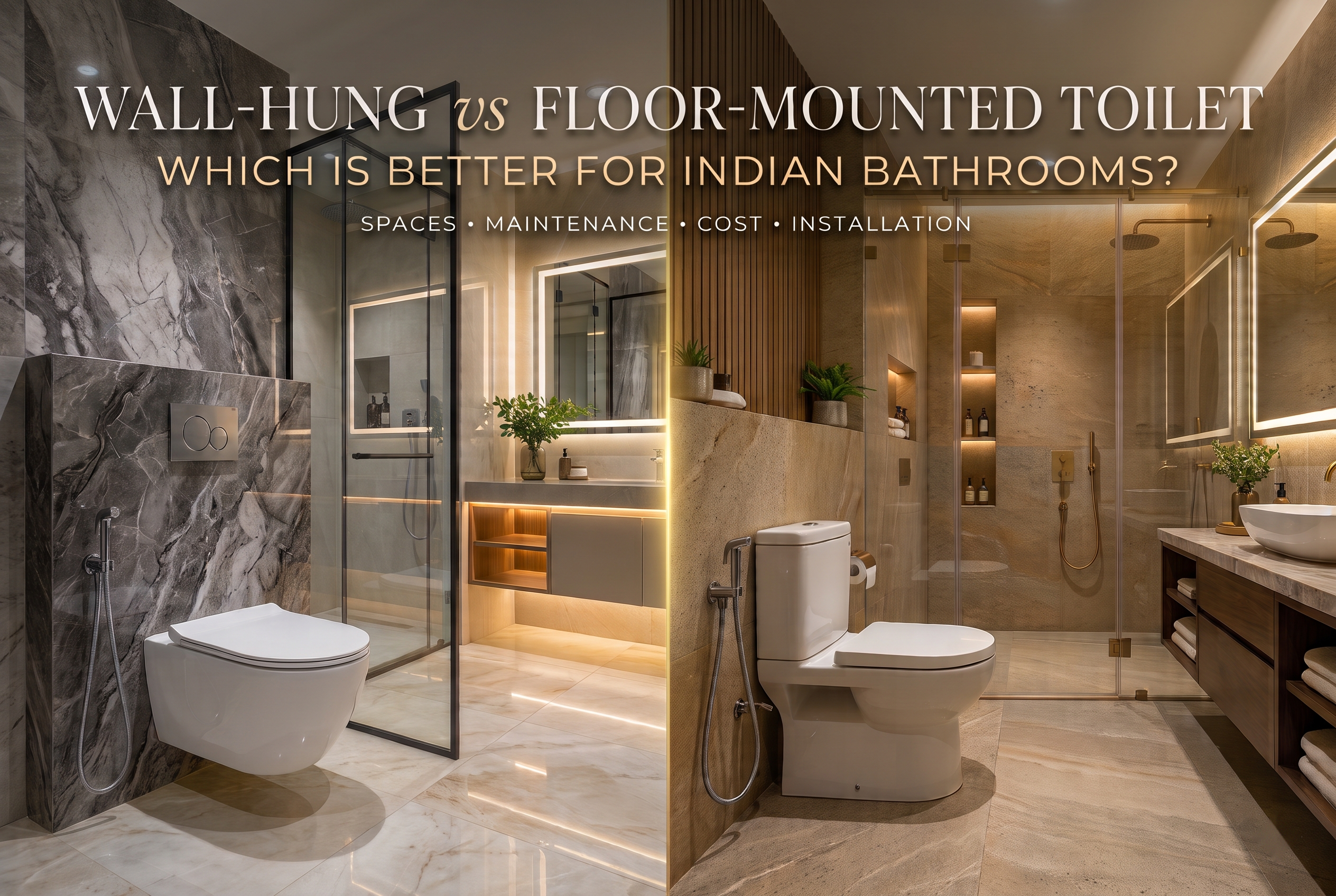
Walk into any new apartment show flat in Mumbai, Pune or Bengaluru today and you will notice something about the bathroom. The toilet seems to float. There is no base, no cistern tank behind it and just a neat flush plate on the wall. That is a wall-hung toilet, and it is fast replacing the classic floor-mounted WC in modern Indian homes.
But is it the right choice for your bathroom? The answer depends on your wall, your budget, your plumbing and even who in the family uses the toilet. In this guide, we compare the wall-hung vs floor-mounted toilet on every point that matters for Indian homes, so you can decide with confidence before you buy.
What Is a Wall-Hung Toilet and a Floor-Mounted Toilet?
Before comparing them, it helps to understand how each one is built and installed.
Wall-hung toilet
A wall-hung toilet (also called a wall-mounted WC) is fixed directly to the wall, with the bowl raised above the floor. The cistern is hidden inside the wall in a concealed cistern with a strong steel frame that carries the weight of the bowl and the user. You flush using a button plate on the wall. Only the bowl is visible, which gives the bathroom a clean, open look.
Floor-mounted toilet
A floor-mounted toilet sits on the floor and is bolted to it. It comes in a few common styles:
- One-piece toilet: The bowl and cistern are moulded as a single unit, so there are fewer joints and gaps.
- Close-coupled (two-piece) toilet: The cistern sits on the back of the bowl and is joined with bolts and a seal.
- Back-to-wall toilet: The bowl sits on the floor flush against the wall, with a concealed cistern behind it. This is a middle path between the two types.
Many older Indian homes have floor-mounted EWCs with an S-trap that drains through the floor. That one detail decides a lot when you plan a switch, as you will see below.
Wall-Hung vs Floor-Mounted Toilet: Quick Comparison
Here is how the two compare side by side on the factors Indian buyers ask about most.
| Factor | Wall-Hung Toilet | Floor-Mounted Toilet |
| Look | Sleek, modern, floating | Classic, familiar |
| Floor space | Floor below stays open; feels bigger | Base and cistern take up visible space |
| Floor cleaning | Very easy; mop runs right under the bowl | Dirt collects around the base and joints |
| Installation | Needs concealed cistern, frame and wall work | Simple; fixed to existing floor outlet |
| Plumbing outlet | Wall outlet (P-trap) | Floor outlet (S-trap) or wall outlet (P-trap) |
| Seat height | Can be set at installation to suit the family | Fixed by the model |
| Repairs | Through the flush plate opening; frame work needs a skilled plumber | Cistern parts are easy to reach |
| Total cost (approx.) | Higher; bowl plus concealed cistern and frame | Lower; one unit, simple fitting |
| Best for | New builds, full renovations, small modern bathrooms | Rentals, quick replacements, tight budgets |
Prices vary widely by brand, model and city, so treat cost as a relative guide and check current rates with your dealer.
Pros and Cons for Indian Bathrooms
Indian bathrooms come with their own realities: wet floors, daily mopping, hard water in many cities, compact apartment layouts and a health faucet next to almost every WC. Here is how each toilet type handles them.
Advantages of a wall-hung toilet
- Easier, more hygienic cleaning: Indian bathrooms are washed often, and water tends to pool around a toilet base. With a wall-hung WC, there is no base, so you can mop or squeegee the whole floor in one go.
- Makes small bathrooms feel larger: Seeing more of the floor tricks the eye into reading the room as bigger. This helps in 1BHK and 2BHK flats where the bathroom is often under 40 sq ft.
- Custom seat height: The bowl can be fixed a little higher for elderly parents or anyone with knee pain, which makes sitting and standing easier.
- Quiet, water-efficient flushing: Most concealed cisterns come with dual flush, using less water for a half flush. Our guide on the benefits of a dual flush cistern explains how much water this can save in a family home.
Disadvantages of a wall-hung toilet
- Higher upfront cost: You pay for the bowl, the concealed cistern, the support frame and the flush plate, plus wall work.
- Needs the right wall: The frame must be anchored to a solid brick or concrete wall, or built into a partition designed for it. Thin or weak walls are not suitable.
- Harder to change later: The cistern is inside the wall. Choose a trusted brand so you rarely need to open it.
Advantages of a floor-mounted toilet
- Budget friendly: Lower product cost and simpler fitting make it the economical choice.
- Easy installation and replacement: It connects to the existing floor outlet, so no wall breaking is needed. Ideal for rented flats and quick upgrades.
- Simple maintenance: If a flush valve or fill valve fails, a local plumber can reach the cistern parts in minutes.
Disadvantages of a floor-mounted toilet
- More areas to clean: The base, bolts and the gap between bowl and cistern trap dirt and moisture.
- Bulkier look: The cistern and base take up visual and floor space, which shows more in compact bathrooms.
- Fixed height: You get the height the model is made with, which may not suit every family member.
Which Toilet Is Better for Your Indian Home?
There is no single winner. The better toilet is the one that fits your situation. Use these common scenarios as a guide.
Building a new home or doing a full renovation: Go wall-hung. The walls are open anyway, so adding a concealed cistern and frame costs far less effort now than later. If you are still planning your budget, our breakdown of bathroom renovation cost in India for 2026 shows where a wall-hung setup fits in.
Small apartment bathroom: Wall-hung is usually the smarter pick because it frees up floor area and visual space. Pair it with a wall-mounted basin for the most open feel. You will find more layout tips in our small bathroom design ideas for India.
Rented flat or quick upgrade: Choose a floor-mounted one-piece or close-coupled toilet. It fits the existing outlet, needs no wall breaking and can be done in a day.
Home with senior citizens: Either works, but a wall-hung toilet lets you set a comfortable seat height. A floor-mounted model with a taller bowl is a good alternative if wall work is not possible.
Old building with a floor outlet (S-trap): A floor-mounted toilet is the simpler fit. Converting to wall-hung means rerouting the drain to the wall, which needs a plumber to check the slope and the floor below.
Buying Checklist Before You Choose
Run through these points with your plumber or interior designer before you finalise.
- Check your drain outlet. Find out if your current toilet drains through the floor (S-trap) or the wall (P-trap). This decides how much plumbing change you need.
- Check the wall. For a wall-hung toilet, confirm the wall is solid enough for a support frame, or plan a frame-supported partition.
- Measure the space. Keep enough clear space in front of the bowl for comfortable use, and plan the door swing so it does not hit the WC.
- Pick a quality concealed cistern. Since it sits inside the wall, the cistern is the part you least want to repair. Browse our range of concealed and slim cisterns from trusted brands.
- Plan the health faucet. Most Indian families use a health faucet with the WC. Fix its point, angle valve and hose length at the planning stage. Our guide to choosing a health faucet for your bathroom covers the options.
- Choose a soft-close seat and rimless bowl. A rimless design is easier to clean, and a soft-close seat avoids slamming and cracks.
- Buy from an authorised dealer. Genuine products come with brand warranty and spare part support, which matters most for in-wall parts.
Once you know what suits your space, you can compare wall-hung, one-piece and close-coupled models side by side in our toilets collection, which features trusted brands like Kohler and American Standard.
Frequently Asked Questions
1. Is a wall-hung toilet strong enough for heavy people?
Yes, when installed correctly. The weight is carried by the steel support frame of the concealed cistern, not by the bowl alone. Good quality frames from reputed brands are tested for loads well above normal body weight. The key is a solid wall and a professional fitting.
2. Can I install a wall-hung toilet in an old bathroom?
Yes, but it needs more work. The plumber must move the drain from the floor to the wall and build in the concealed cistern and frame. This is easiest during a full renovation, when tiles are being redone anyway.
3. What happens if the concealed cistern needs repair?
Most repairs, like fixing the flush valve or fill valve, are done through the opening behind the flush plate. You do not need to break tiles. This is why choosing a branded cistern with available spare parts matters.
4. Which toilet is easier to clean in Indian bathrooms?
The wall-hung toilet. With no base touching the floor, you can mop under it easily and there are fewer joints for dirt and moisture to collect. This suits Indian bathrooms that are washed frequently.
5. Is a wall-hung toilet more expensive than a floor-mounted toilet?
Usually yes. You buy the bowl, a concealed cistern, a frame and a flush plate, and pay for wall work. A floor-mounted one-piece or close-coupled toilet is more budget friendly and quicker to install.
6. Which toilet is best for a small bathroom in India?
A wall-hung toilet is generally the better choice for small bathrooms because it keeps the floor visible and makes the room feel more spacious. If wall work is not possible, a compact one-piece floor-mounted toilet is a good alternative.
7. Can I use a health faucet with a wall-hung toilet?
Yes. A health faucet works with both types. Just plan the water point and angle valve beside the WC before tiling, so the hose reaches comfortably.
Final Word: Wall-Hung or Floor-Mounted?
If you are building new or renovating fully, and want a modern bathroom that is easy to clean and feels spacious, a wall-hung toilet is worth the extra investment. If you need a quick, affordable upgrade or live in a rented flat, a well-made floor-mounted toilet will serve you just as reliably.
Whichever you choose, quality matters more than style. A good concealed cistern, a rimless bowl and genuine brand warranty will save you years of trouble.
Walk into any new apartment show flat in Mumbai, Pune or Bengaluru today and you will notice something about the bathroom. The toilet seems to float. There is no base, no cistern tank behind it and just a neat flush plate on the wall. That is a wall-hung toilet, and it is fast replacing the classic floor-mounted WC in modern Indian homes.
But is it the right choice for your bathroom? The answer depends on your wall, your budget, your plumbing and even who in the family uses the toilet. In this guide, we compare the wall-hung vs floor-mounted toilet on every point that matters for Indian homes, so you can decide with confidence before you buy.
What Is a Wall-Hung Toilet and a Floor-Mounted Toilet?
Before comparing them, it helps to understand how each one is built and installed.
Wall-hung toilet
A wall-hung toilet (also called a wall-mounted WC) is fixed directly to the wall, with the bowl raised above the floor. The cistern is hidden inside the wall in a concealed cistern with a strong steel frame that carries the weight of the bowl and the user. You flush using a button plate on the wall. Only the bowl is visible, which gives the bathroom a clean, open look.
Floor-mounted toilet
A floor-mounted toilet sits on the floor and is bolted to it. It comes in a few common styles:
- One-piece toilet: The bowl and cistern are moulded as a single unit, so there are fewer joints and gaps.
- Close-coupled (two-piece) toilet: The cistern sits on the back of the bowl and is joined with bolts and a seal.
- Back-to-wall toilet: The bowl sits on the floor flush against the wall, with a concealed cistern behind it. This is a middle path between the two types.
Many older Indian homes have floor-mounted EWCs with an S-trap that drains through the floor. That one detail decides a lot when you plan a switch, as you will see below.
Wall-Hung vs Floor-Mounted Toilet: Quick Comparison
Here is how the two compare side by side on the factors Indian buyers ask about most.
| Factor | Wall-Hung Toilet | Floor-Mounted Toilet |
| Look | Sleek, modern, floating | Classic, familiar |
| Floor space | Floor below stays open; feels bigger | Base and cistern take up visible space |
| Floor cleaning | Very easy; mop runs right under the bowl | Dirt collects around the base and joints |
| Installation | Needs concealed cistern, frame and wall work | Simple; fixed to existing floor outlet |
| Plumbing outlet | Wall outlet (P-trap) | Floor outlet (S-trap) or wall outlet (P-trap) |
| Seat height | Can be set at installation to suit the family | Fixed by the model |
| Repairs | Through the flush plate opening; frame work needs a skilled plumber | Cistern parts are easy to reach |
| Total cost (approx.) | Higher; bowl plus concealed cistern and frame | Lower; one unit, simple fitting |
| Best for | New builds, full renovations, small modern bathrooms | Rentals, quick replacements, tight budgets |
Prices vary widely by brand, model and city, so treat cost as a relative guide and check current rates with your dealer.
Pros and Cons for Indian Bathrooms
Wall-Hung vs Floor-Mounted Toilet Indian bathrooms come with their own realities: wet floors, daily mopping, hard water in many cities, compact apartment layouts and a health faucet next to almost every WC. Here is how each toilet type handles them.
Advantages of a wall-hung toilet
- Easier, more hygienic cleaning: Indian bathrooms are washed often, and water tends to pool around a toilet base. With a wall-hung WC, there is no base, so you can mop or squeegee the whole floor in one go.
- Makes small bathrooms feel larger: Seeing more of the floor tricks the eye into reading the room as bigger. This helps in 1BHK and 2BHK flats where the bathroom is often under 40 sq ft.
- Custom seat height: The bowl can be fixed a little higher for elderly parents or anyone with knee pain, which makes sitting and standing easier.
- Quiet, water-efficient flushing: Most concealed cisterns come with dual flush, using less water for a half flush. Our guide on the benefits of a dual flush cistern explains how much water this can save in a family home.
Disadvantages of a wall-hung toilet
- Higher upfront cost: You pay for the bowl, the concealed cistern, the support frame and the flush plate, plus wall work.
- Needs the right wall: The frame must be anchored to a solid brick or concrete wall, or built into a partition designed for it. Thin or weak walls are not suitable.
- Harder to change later: The cistern is inside the wall. Choose a trusted brand so you rarely need to open it.
Advantages of a floor-mounted toilet
- Budget friendly: Lower product cost and simpler fitting make it the economical choice.
- Easy installation and replacement: It connects to the existing floor outlet, so no wall breaking is needed. Ideal for rented flats and quick upgrades.
- Simple maintenance: If a flush valve or fill valve fails, a local plumber can reach the cistern parts in minutes.
Disadvantages of a floor-mounted toilet
- More areas to clean: The base, bolts and the gap between bowl and cistern trap dirt and moisture.
- Bulkier look: The cistern and base take up visual and floor space, which shows more in compact bathrooms.
- Fixed height: You get the height the model is made with, which may not suit every family member.
Which Toilet Is Better for Your Indian Home?
There is no single winner. The better toilet is the one that fits your situation. Use these common scenarios as a guide.
Building a new home or doing a full renovation: Go wall-hung. The walls are open anyway, so adding a concealed cistern and frame costs far less effort now than later. If you are still planning your budget, our breakdown of bathroom renovation cost in India for 2026 shows where a wall-hung setup fits in.
Small apartment bathroom: Wall-hung is usually the smarter pick because it frees up floor area and visual space. Pair it with a wall-mounted basin for the most open feel. You will find more layout tips in our small bathroom design ideas for India.
Rented flat or quick upgrade: Choose a floor-mounted one-piece or close-coupled toilet. It fits the existing outlet, needs no wall breaking and can be done in a day.
Home with senior citizens: Either works, but a wall-hung toilet lets you set a comfortable seat height. A floor-mounted model with a taller bowl is a good alternative if wall work is not possible.
Old building with a floor outlet (S-trap): A floor-mounted toilet is the simpler fit. Converting to wall-hung means rerouting the drain to the wall, which needs a plumber to check the slope and the floor below.
Buying Checklist Before You Choose
Run through these points with your plumber or interior designer before you finalise.
- Check your drain outlet. Find out if your current toilet drains through the floor (S-trap) or the wall (P-trap). This decides how much plumbing change you need.
- Check the wall. For a wall-hung toilet, confirm the wall is solid enough for a support frame, or plan a frame-supported partition.
- Measure the space. Keep enough clear space in front of the bowl for comfortable use, and plan the door swing so it does not hit the WC.
- Pick a quality concealed cistern. Since it sits inside the wall, the cistern is the part you least want to repair. Browse our range of concealed and slim cisterns from trusted brands.
- Plan the health faucet. Most Indian families use a health faucet with the WC. Fix its point, angle valve and hose length at the planning stage. Our guide to choosing a health faucet for your bathroom covers the options.
- Choose a soft-close seat and rimless bowl. A rimless design is easier to clean, and a soft-close seat avoids slamming and cracks.
- Buy from an authorised dealer. Genuine products come with brand warranty and spare part support, which matters most for in-wall parts.
Once you know what suits your space, you can compare wall-hung, one-piece and close-coupled models side by side in our toilets collection, which features trusted brands like Kohler and American Standard.
Frequently Asked Questions
1. Is a wall-hung toilet strong enough for heavy people?
Yes, when installed correctly. The weight is carried by the steel support frame of the concealed cistern, not by the bowl alone. Good quality frames from reputed brands are tested for loads well above normal body weight. The key is a solid wall and a professional fitting.
2. Can I install a wall-hung toilet in an old bathroom?
Yes, but it needs more work. The plumber must move the drain from the floor to the wall and build in the concealed cistern and frame. This is easiest during a full renovation, when tiles are being redone anyway.
3. What happens if the concealed cistern needs repair?
Most repairs, like fixing the flush valve or fill valve, are done through the opening behind the flush plate. You do not need to break tiles. This is why choosing a branded cistern with available spare parts matters.
4. Which toilet is easier to clean in Indian bathrooms?
The wall-hung toilet. With no base touching the floor, you can mop under it easily and there are fewer joints for dirt and moisture to collect. This suits Indian bathrooms that are washed frequently.
5. Is a wall-hung toilet more expensive than a floor-mounted toilet?
Usually yes. You buy the bowl, a concealed cistern, a frame and a flush plate, and pay for wall work. A floor-mounted one-piece or close-coupled toilet is more budget friendly and quicker to install.
6. Which toilet is best for a small bathroom in India?
A wall-hung toilet is generally the better choice for small bathrooms because it keeps the floor visible and makes the room feel more spacious. If wall work is not possible, a compact one-piece floor-mounted toilet is a good alternative.
7. Can I use a health faucet with a wall-hung toilet?
Yes. A health faucet works with both types. Just plan the water point and angle valve beside the WC before tiling, so the hose reaches comfortably.
Final Word: Wall-Hung or Floor-Mounted?
If you are building new or renovating fully, and want a modern bathroom that is easy to clean and feels spacious, a wall-hung toilet is worth the extra investment. If you need a quick, affordable upgrade or live in a rented flat, a well-made floor-mounted toilet will serve you just as reliably.
Whichever you choose, quality matters more than style. A good concealed cistern, a rimless bowl and genuine brand warranty will save you years of trouble.
Still unsure which one suits your bathroom? Visit the Monarch Bath showroom at Null Bazar, Mumbai, or contact the Monarch Bath team for expert advice on the right toilet, cistern and fittings for your home.