





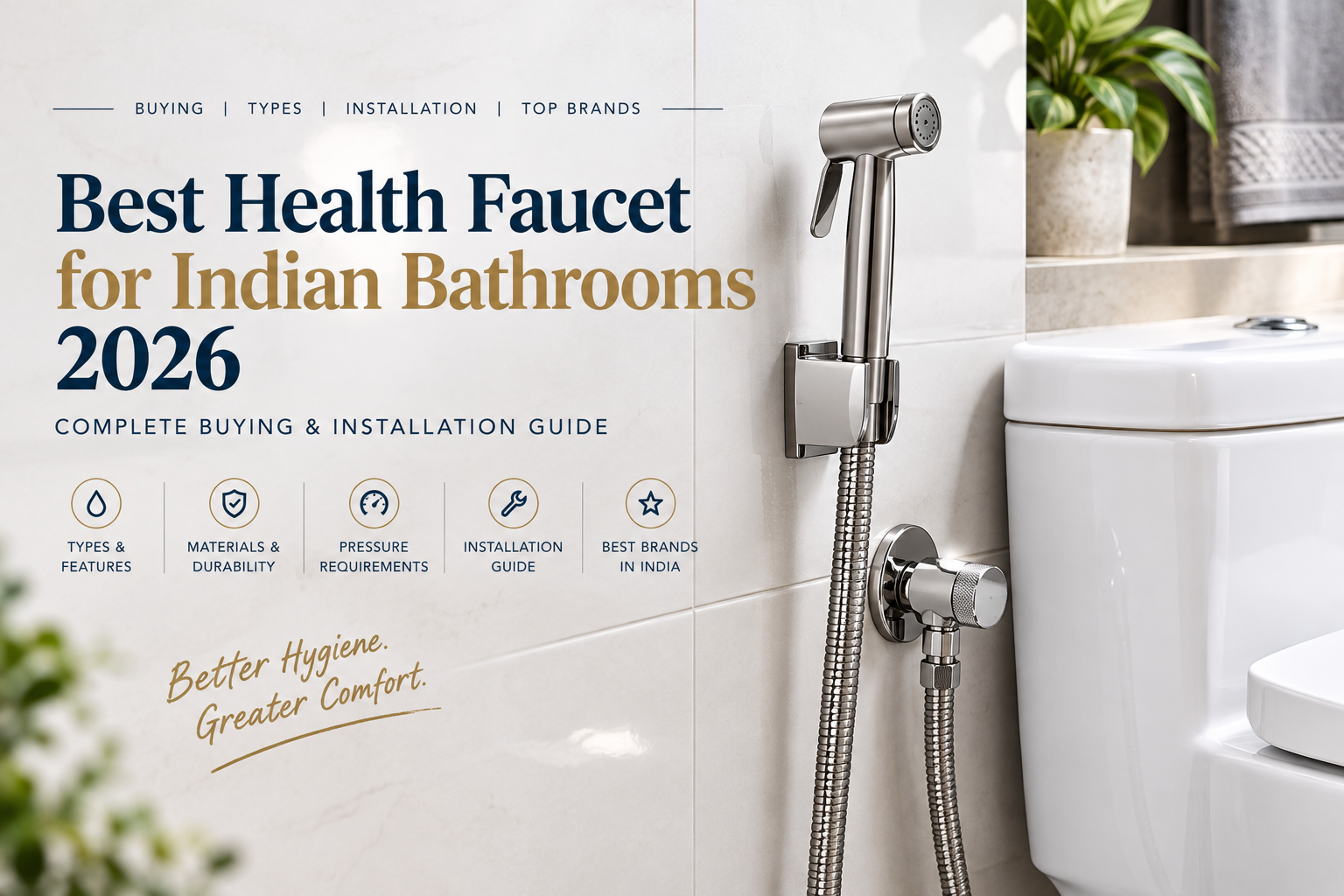
A health faucet is the single most used fitting in an Indian bathroom, yet it is typically bought last, with the least thought, and from the lowest-price option on the shelf. The result is a faucet that leaks within a year, loses pressure in low-water-pressure buildings, or corrodes at the hose fitting within 18 months of installation. This guide covers what to look for when buying a health faucet in India in 2026, which materials and types suit Mumbai’s water conditions, and how installation works in a standard flat.
Contents
- Why a Health Faucet Is Standard in Every Indian Bathroom
- Types of Health Faucet Compared
- Single-Jet vs Multi-Function Health Faucets
- What to Check Before Buying
- Health Faucet Brands Available in India
- Installation: How It Fits in a Mumbai Flat
- Mistakes to Avoid When Buying a Health Faucet
- What to Take Away
- Frequently Asked Questions
Why a Health Faucet Is Standard in Every Indian Bathroom
It addresses Indian hygiene expectations. Indian bathroom culture centres on water-based cleaning rather than paper-only cleaning. A health faucet delivers directed water flow at the point of use, which is the simplest and most cost-effective way to meet this expectation in any bathroom type, from a compact flat to a luxury apartment.
It retrofits without toilet modification. Unlike a bidet seat or an integrated rim-wash system, a health faucet connects to the existing cold-water supply line and requires no changes to the toilet itself. This makes it the practical default in rental properties, resale flats, and any bathroom where replacing the toilet is not part of the renovation scope.
It covers a wide price range. A functional, durable health faucet costs Rs 1,200 to Rs 4,000 from a recognised brand. At this price point, it is often the lowest-cost improvement in a bathroom that provides daily-use benefit. It is also one of the easiest fittings to replace independently without a full bathroom renovation.
Monarch Bath stocks health faucets across all price tiers from confirmed brand partners including Jaquar, Hindware, Grohe, and Schell. See the Mumbai bathroom accessories guide for how a health faucet fits into a complete bathroom fitting plan.
Types of Health Faucet Compared
The health faucet market in India divides into three main types based on jet pattern and function. Each suits a different pressure environment and usage preference.
| Type | Jet Pattern | Min Pressure | Best For | Price Range (Rs) |
| Single-Jet | One concentrated stream | 0.5 bar | Low-pressure buildings, simple use | 300 to 2,500 |
| Multi-Jet | Multiple streams, wide spray | 1.0 bar | Adequate pressure, versatile use | 800 to 5,000 |
| Multi-Function | Switchable: jet, spray, mist | 1.5 bar | High-pressure buildings, premium use | 2,000 to 15,000 |
Single-jet remains the most widely installed health faucet type in Indian homes because it works reliably at the variable and often low water pressure common in Mumbai apartment buildings. Multi-function models from Grohe and Schell deliver a noticeably better experience where water pressure is consistent, but they underperform in buildings with pressure below 1.5 bar.
Single-Jet vs Multi-Function Health Faucets
Single-jet health faucets. The trigger controls water flow directly: press for water, release to stop. There are no moving parts beyond the trigger valve, which is why single-jet models outlast multi-function ones in hard-water conditions. The nozzle is a single opening with no cartridge to block. When the water supply is inconsistent or the pressure drops seasonally (as it does in many Mumbai buildings during summer), a single-jet health faucet continues to work where a multi-function model loses its spray pattern entirely.
Multi-function health faucets. A selector ring or button switches between jet, spray, and mist patterns. Each pattern serves a different use case: jet for direct cleaning, spray for rinsing, mist for surface wetting. The mechanism that enables pattern switching is a small cartridge with multiple channels. Hard water deposits calcium on these channels, and over time the cartridge blocks partially or seizes. In cities with soft water, multi-function models work well for 5 to 7 years. In Mumbai, the maintenance requirement is higher.
For a comparison of how health faucets complement other essential bathroom accessories, Monarch Bath’s accessory guide covers the full set of fittings needed for a functional Indian bathroom.
What to Check Before Buying: Pressure, Material, and Valve
These four factors determine whether a health faucet performs reliably in an Indian bathroom over a 5-year period.
- Operating pressure rating. Check the packaging or product page for a minimum operating pressure specification. A health faucet rated for 0.5 bar minimum works in most Mumbai buildings, including older constructions with tank-fed supply. One rated 1.0 bar minimum will underperform in the same building during peak demand hours.
- Hose material. Stainless steel braided hose is the correct choice for Indian water conditions. It is resistant to hard-water mineral buildup on the exterior and holds its shape under pressure without ballooning. PVC hoses are acceptable for the first year but become brittle with temperature cycling and UV exposure where the hose runs through a sunlit area.
- Head material. ABS plastic heads are standard at all price points up to Rs 2,500. They are light, rust-proof, and adequate for most applications. Brass heads add weight, better thread durability at the hose connection, and longer cartridge life in hard-water conditions. The upgrade from ABS to brass is worth Rs 500 to Rs 1,500 extra.
- Trigger valve type. A half-press trigger allows flow-rate control and reduces water waste. A full-press-only trigger is simpler and more reliable long-term. For children’s bathrooms or households where water conservation is a priority, the half-press type is the better choice despite its higher initial cost.
Monarch Bath’s showroom team can advise on which health faucet specification suits a specific building’s water pressure. See also the toilet accessories selection guide for fitting choices that work alongside a health faucet in the toilet area.
Health Faucet Brands Available in India
The health faucet market in India runs from unbranded commodity products to engineered European designs. The table below covers the confirmed brand tiers available through Monarch Bath.
| Brand Tier | Examples | Price Range (Rs) | Hose Included | Warranty |
| Entry | Unbranded, generic Indian | 300 to 800 | Usually PVC | None or 1 year |
| Mid-Range | Hindware, Marc India, Jaquar | 1,200 to 4,000 | SS braided | 1 to 3 years |
| Premium | Grohe, Schell | 5,000 to 15,000 | SS braided, longer | 3 to 5 years |
Jaquar offers the widest mid-range selection for the Indian market and its service network covers Mumbai comprehensively. Hindware and Marc India provide reliable mid-range options at the lower end of the Rs 1,200 to Rs 4,000 range. Grohe and Schell are the correct choice where water pressure is adequate and a longer-lasting, better-feeling product is the priority. Unbranded health faucets from Rs 300 to Rs 800 are not recommended for permanent installation; the hose fittings and trigger valves fail within 12 to 18 months under daily use.
For context on how these brands perform across other bathroom fittings, see the toilet trends and fittings guide.
Installation: How It Fits in a Mumbai Flat
A health faucet installation is one of the simpler plumbing jobs in a bathroom. A competent plumber completes a standard installation in 30 to 60 minutes. The steps below describe a typical Mumbai flat installation.
- Locate the cold-water supply line near the toilet. In most Mumbai flats, the supply enters through the wall or floor near the toilet cistern. This is the line the health faucet taps into. If the line runs to the cistern only, a T-junction fitting at the supply point diverts flow to both the cistern and the health faucet.
- Install a shut-off valve on the health faucet branch. The shut-off valve allows the health faucet to be turned off or removed for maintenance without shutting off water to the cistern or the rest of the bathroom. This is a standard fitting that adds Rs 200 to Rs 600 to the installation cost.
- Connect the braided hose between the shut-off valve and the faucet. Hand-tighten the hose connections first, then add a quarter turn with a spanner. Over-tightening strips the threads on the faucet body. Check all connections for seepage before using the faucet.
- Fix the holder to the wall at the correct height. The holder keeps the health faucet within reach of the toilet user without the hose running taut. Standard mounting height is 900 to 1,000 mm from the floor, on the wall beside the toilet. Use a rawl plug and stainless steel screw; plastic plugs in tiled walls work loose within a year under the repeated weight of the faucet being replaced in the holder.
If the existing supply line has no T-junction and no accessible isolation point, the plumber will need to break into the supply line, which adds Rs 500 to Rs 1,500 to the job. Get this scope confirmed before starting. For broader guidance on toilet-area planning, see the toilet designs for small spaces guide.
Mistakes to Avoid When Buying a Health Faucet
Buying on price without checking pressure compatibility. A multi-function health faucet from a recognised brand at Rs 2,500 performs worse than a mid-range single-jet at Rs 1,500 in a building with 0.7 bar water pressure. The pressure specification on the box is the most important number to check before purchase, not the brand or the number of spray settings.
Choosing a PVC hose to save Rs 200. The braided stainless steel hose that comes with a mid-range health faucet is the component most worth paying for. PVC hoses balloon at hose fittings under pressure, develop micro-cracks from temperature cycling, and fail at the worst moment. The Rs 200 to Rs 500 premium for a SS braided hose delivers 3 to 5 years of additional service life.
Skipping the shut-off valve. A health faucet without an isolation valve near the connection point means the main water supply for the entire flat must be shut off every time the faucet needs maintenance or replacement. Fitting a shut-off valve at installation costs Rs 200 to Rs 600 and saves that inconvenience for the entire product life.
Mounting the holder too high or too far from the toilet. A health faucet holder mounted at 1,200 mm from the floor or on a wall more than 600 mm from the toilet puts the hose under tension during use and accelerates wear at the connection points. Mount the holder at 900 to 1,000 mm, within arm’s reach of the toilet seat.
For ideas on building a complete, low-maintenance Indian bathroom, the custom bathroom design tips guide covers fitting selection, layout planning, and brand decisions in one place.
What to Take Away
- A health faucet rated for 0.5 bar minimum operating pressure suits most Mumbai apartment buildings; check this before buying, not after.
- Single-jet models are the most reliable choice for Indian water conditions; multi-function models suit high-pressure buildings only.
- Stainless steel braided hose and a brass or quality ABS head deliver the best durability-to-cost ratio at the mid-range price point.
- Jaquar, Hindware, and Marc India cover the mid-range well; Grohe and Schell are the correct premium choice where pressure is consistent.
- Always fit a shut-off valve on the health faucet branch at installation; it costs under Rs 600 and eliminates future supply interruptions during maintenance.
- Replace the hose every 3 years regardless of its visible condition; hose failure is the most common cause of bathroom water damage from a health faucet.
Frequently Asked Questions
1. What is the difference between a health faucet and a bidet spray?
A health faucet is a handheld nozzle on a flexible hose connected to the cold-water supply near the toilet. A bidet spray or bidet seat is a fixed fitting built into or attached to the toilet unit. In India, the detachable health faucet is the standard format. It installs without modifying the toilet and is compatible with all standard Indian toilet models.
2. Which health faucet works with low water pressure?
Single-jet health faucets with a wide trigger and smooth-bore hose work best at low water pressure. Look for a model rated for a minimum of 0.5 bar operating pressure. Avoid multi-jet or multi-function models in buildings with water pressure below 1 bar; they require higher pressure to switch between spray patterns effectively.
3. What material is best for a health faucet pipe in India?
Stainless steel braided hose is the most durable option for Indian water conditions and is resistant to hard-water corrosion and UV damage. PVC hoses are acceptable in low-pressure situations but crack over time with sun exposure. ABS plastic heads are standard across all price ranges; full-brass heads are more durable and worth the premium for long-term use.
4. How do I install a health faucet in my bathroom?
A health faucet installs into the existing cold-water supply line near the toilet via a T-junction connector, a shut-off valve, and a wall-mounted holder. Most installations take under one hour. A plumber is recommended if the existing supply line does not already have a T-junction or an isolation valve near the toilet.
5. What is the price range of a health faucet in India in 2026?
Entry-level plastic health faucets in India start at Rs 300 to Rs 800. Mid-range brass or stainless steel models from brands such as Jaquar, Hindware, or Marc India range from Rs 1,200 to Rs 4,000. Premium models from Grohe or Schell range from Rs 5,000 to Rs 15,000 with longer warranties and better flow control.
6. How long does a health faucet last before replacement?
A mid-range brass health faucet with a stainless steel hose lasts 5 to 8 years under normal use. Plastic models typically last 2 to 4 years before the trigger mechanism or hose fitting fails. Hard water accelerates wear on the nozzle and hose fittings. Replacing the hose every 3 years, even if the head is intact, reduces leak risk significantly.