





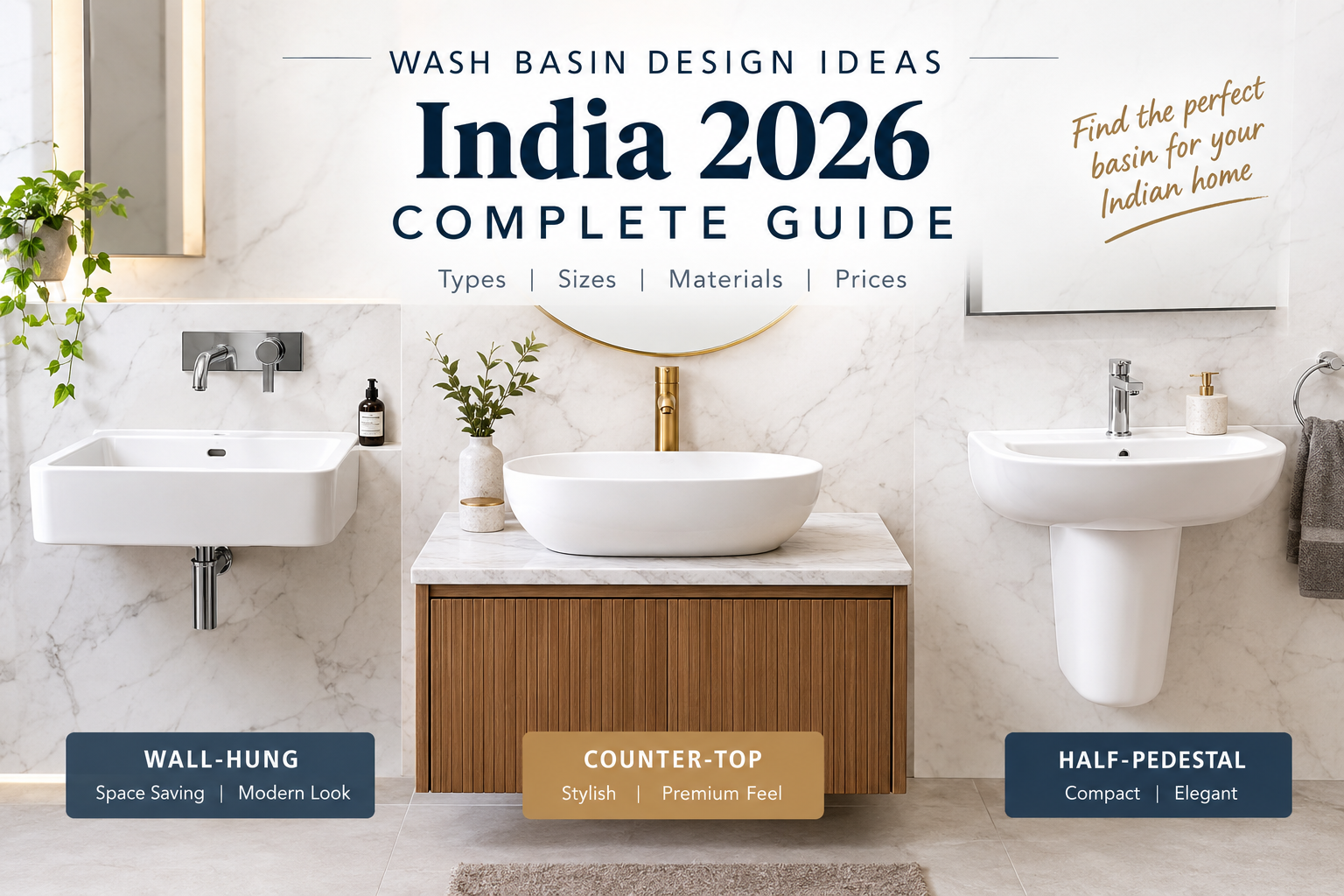
Wash basin design is one of the most overlooked decisions in a bathroom renovation. Most homeowners pick a basin based on the display model in a showroom without checking whether the type, size, or fixing method suits their actual bathroom layout. A counter-top basin that reads as elegant in a showroom can make a 35-square-foot Mumbai flat feel smaller and harder to maintain. This guide covers the wash basin design options that work in Indian bathrooms, with size guidance, material comparisons, and price benchmarks for 2026.
Contents
- Why the Basin Choice Shapes the Whole Bathroom
- Types of Wash Basin Design in India
- Counter-Top Basins: Style Versus Practicality
- Wall-Hung and Semi-Recessed Basins for Mumbai Flats
- Pedestal and Half-Pedestal Basins
- Materials: Ceramic, Vitreous China, and Quartz
- How to Choose the Right Wash Basin Design
- What to Take Away
- Frequently Asked Questions
Why the Basin Choice Shapes the Whole Bathroom
Floor space visible below the basin. A pedestal basin conceals the plumbing but fills the floor-to-basin gap with a solid column. A wall-hung basin leaves the floor entirely open, and the eye reads the room as larger because of it.
The tap position. Different basin types require different tap configurations. A counter-top basin usually requires a wall-mount or back-to-wall tap. A pedestal basin requires a pillar tap with a long body. Choosing the wrong combination means a plumbing reroute after installation.
Cleaning access. A basin that traps dirt at the base seam, behind a pedestal column, or under a counter-top overhang adds time to every cleaning session. In a household with hard water, this is a daily friction point worth solving at the purchase stage.
Monarch Bath stocks all major basin types across confirmed brands including Jaquar, Duravit, Hindware, Kohler, Toto, and American Standard. The Mumbai bathroom accessories guide covers how basin type fits into a broader bathroom plan. The decision comes down less to what looks best in isolation and more to what works within a specific layout, wall type, and budget.
Types of Wash Basin Design in India
The wash basin design market in India divides into five main types. Each suits a different bathroom size, budget, and layout constraint.
| Basin Type | Best For | Min Width | Price Range (Rs) | Plumbing Visible? |
| Counter-Top | Vanity-led bathrooms, 50+ sq ft | 420 mm | 8,000 to 60,000 | No (hidden in vanity) |
| Wall-Hung | Compact modern bathrooms | 400 mm | 5,000 to 80,000 | No (pipes in wall) |
| Semi-Recessed | Small bathrooms with narrow counter | 480 mm | 6,000 to 40,000 | Partially |
| Pedestal | Traditional or large bathrooms | 500 mm | 2,500 to 30,000 | No (hidden by pedestal) |
| Half-Pedestal | Modern look, compact footprint | 500 mm | 4,000 to 35,000 | Partially |
Price ranges reflect the Indian market in 2026 across entry-level to premium brands. Tap and waste fittings are not included. Installation charges in Mumbai range from Rs 2,000 to Rs 6,000 for a standard basin swap, and higher for wall-hung types requiring in-wall plumbing work.
Counter-Top Basins: Style Versus Practicality
A counter-top basin sits fully above the vanity surface, with the bowl visible from the sides and top. The design reads as the centrepiece of the bathroom, which is why it appears in premium hotel bathrooms and high-budget residential renovations across Mumbai.
What works in Indian homes. Counter-top basins suit bathrooms of 50 square feet or more where a full vanity unit fits without blocking the door swing. The vanity below provides storage that Indian bathrooms typically lack. Duravit, Kohler, and Toto offer premium counter-top wash basin design options; Hindware and Marc India cover the mid-range at accessible price points.
What does not work. Counter-top basins require a water-resistant vanity surface. In Mumbai’s humidity, MDF vanity tops warp within 18 to 24 months unless properly sealed. A granite or quartz counter-top surface adds Rs 8,000 to Rs 20,000 to the project cost. The basin joint at the base also traps water and soap residue, which becomes a maintenance issue in hard-water households.
For tap options suited to counter-top wash basin design and Indian water pressure, see Monarch Bath’s American Standard wall-mount basin faucet guide and the square waterfall basin taps overview.
Wall-Hung and Semi-Recessed Basins for Mumbai Flats
Wall-hung and semi-recessed basins are the most practical wash basin design choices for the compact bathrooms that make up the majority of Mumbai’s residential stock.
- Wall-hung basin: Fixed entirely to the wall with no support below. The floor beneath the basin stays completely open, which is the biggest single space-efficiency gain available in a small bathroom. Requires fixing into a solid wall or a proprietary frame where the wall is hollow.
- Semi-recessed basin: Partially set into a narrow shelf or counter. The basin projects 250 to 350 mm from the wall rather than the 500 mm of a standard counter-top. Provides a small surface for toiletries without the space commitment of a full vanity unit.
- Height flexibility: Wall-hung basins can be set at any height, which matters for households with mixed-height users or for accessible-bathroom requirements. Standard installation height in India is 800 to 850 mm from floor to basin rim.
- Plumbing requirement: Both types require supply and waste pipes to run within the wall or in a concealed surface chase. Surface-mounted pipes in a rental flat are acceptable but affect the finished appearance.
- Load rating: Most wall-hung basins carry a rated load of 100 to 150 kg. This rating applies to the wall fixing and the frame. Confirm the wall type and specify the correct frame before purchasing.
Monarch Bath carries wall-hung and semi-recessed wash basin designs across Jaquar, Duravit, Hindware, and American Standard. The full basin selection guide covers sizing and brand comparisons for different bathroom layouts.
Pedestal and Half-Pedestal Basins
A pedestal basin is the original wash basin design for Indian bathrooms and remains the most widely installed type across the country. The pedestal conceals the waste trap, supply pipes, and fixing hardware in a single vertical column. The result is a clean, self-contained look that requires no cabinetry and no in-wall plumbing work beyond what any basin requires.
A half-pedestal basin replaces the floor-standing column with a shorter bracket fixed to the wall. The plumbing is partially concealed; the wall beneath the basin stays open. This gives the half-pedestal a more contemporary profile than a full pedestal while keeping the same concealment function at lower installation cost than a fully wall-hung basin.
Both types work at any bathroom size. The primary consideration is aesthetic: in a contemporary, tile-led bathroom, a traditional full pedestal reads as dated. In a period property or a traditionally styled home, it reads as the correct and appropriate choice. The half-pedestal bridges both contexts well.
Hindware, American Standard, Jaquar, and Marc India all offer pedestal and half-pedestal wash basin designs at mid-range prices. See the wash basin materials trend guide for comparisons across pedestal, counter-top, and wall-hung types from each brand.
Materials: Ceramic, Vitreous China, and Quartz
The material of a wash basin determines its durability under Indian water conditions, its resistance to staining, and its long-term maintenance requirement. These factors matter significantly in Mumbai, where water hardness varies by building and supply source.
| Material | Durability | Hard-Water Resistance | Maintenance | Price vs Ceramic |
| Ceramic | Good | Moderate | Low | Base level |
| Vitreous China | Very Good | High | Low | +10 to 20% |
| Quartz Composite | Excellent | Very High | Moderate | +40 to 80% |
| Resin / Acrylic | Fair | Low | High | Varies widely |
| Natural Stone | Good | Low (unsealed) | High | +100% or more |
Vitreous china is the recommended choice for Indian water conditions across all wash basin design types. The glass-fired exterior layer is non-porous and does not absorb mineral deposits the way raw ceramic does. Most basins from Jaquar, Kohler, and Toto in the Indian market use vitreous china as standard. Quartz composite is worth the premium in households where the basin sees heavy daily use or where aesthetics are a priority.
How to Choose the Right Wash Basin Design
The four steps below narrow the wash basin design choice from the full market to a short list before the budget conversation begins.
- Measure the wall space first. Note the distance from the wall to the nearest obstruction: door, toilet, or shower screen. A basin that projects 550 mm from the wall into a 900 mm clearance zone leaves only 350 mm of turning space, below the 600 mm minimum for comfortable use. Wall-hung and semi-recessed designs typically project 400 to 450 mm and recover the margin.
- Confirm the wall type. Wall-hung basins require a solid or frame-reinforced wall. Hollow partition walls common in newer Mumbai construction need a dedicated concealed frame, which adds Rs 5,000 to Rs 12,000 to the installation cost. Pedestal and counter-top basins have no wall-strength requirement beyond standard anchor bolts.
- Decide on tap position before choosing the basin. Counter-top basins with no tap deck require wall-mounted taps. Pedestal basins require a pillar tap. Wall-hung basins with a tap deck accept standard mixer taps. Choosing the basin before confirming tap availability is one of the most common renovation sequencing mistakes and results in expensive plumbing changes.
- Budget for waste, tap, and installation separately. A waste fitting adds Rs 500 to Rs 3,000. A basin mixer tap adds Rs 3,000 to Rs 25,000. Plumber installation in Mumbai ranges from Rs 2,000 to Rs 6,000 for a standard basin swap and more for counter-top and wall-hung types because of the additional fixing and plumbing work involved.
Monarch Bath’s showroom in Mumbai carries all major wash basin design types across confirmed brand partners. For ideas on how wash basin design integrates with the wider bathroom plan, see the custom bathroom and kitchen design guide.
What to Take Away
- Wall-hung wash basin design delivers the most space efficiency in compact Mumbai bathrooms and is the best default for rooms under 50 square feet.
- Pedestal basins remain practical and affordable; they suit traditional interiors and situations where wall-hung installation is not feasible.
- Counter-top basins require a water-resistant vanity surface and suit bathrooms of 50 square feet or more with proper cabinetry.
- Vitreous china is the most practical material for Indian water conditions across all wash basin design types.
- Budget separately for the tap, waste fitting, and installation; these add Rs 5,000 to Rs 34,000 on top of the basin price.
- Confirm wall type and tap position before finalising the basin selection to avoid rework.
Frequently Asked Questions
1. What is the best wash basin design for a small Indian bathroom?
A wall-hung basin is the best wash basin design for a small Indian bathroom. It frees up floor space, makes the room easier to clean, and creates a sense of visual openness. A semi-recessed basin works well where wall-fixing is not possible. Keep the basin width between 450 and 500 mm for small-bathroom proportions.
2. What is the difference between a counter-top and a wall-hung basin?
A counter-top basin sits on top of a vanity surface and requires a full vanity unit below it. A wall-hung basin is fixed directly to the wall with no support below, freeing up floor space and making the room feel larger. Counter-top basins suit vanity-led bathrooms; wall-hung basins suit compact spaces and minimalist designs.
3. How do I choose the right basin size for my bathroom?
Measure the available wall length first. A single-user bathroom in a Mumbai flat typically suits a basin of 450 to 550 mm in width. A shared bathroom benefits from 600 mm or more. The basin depth from wall to front edge should leave at least 600 mm of clear turning space in front of it.
4. Which basin material is most durable for Indian water conditions?
Vitreous china is the most durable and practical option for Indian water conditions. It is non-porous, resistant to hard-water staining, and easy to clean. Ceramic is similar but slightly thinner-walled. Quartz composite is more scratch-resistant but comes at a higher price. Avoid resin basins in areas with very hard water.
5. What is the price range of wash basins in India in 2026?
Entry-level ceramic wash basins in India start at Rs 2,500 to Rs 6,000. Mid-range vitreous china basins from brands such as Hindware or Marc India range from Rs 8,000 to Rs 25,000. Premium basins from Duravit, Kohler, or Toto range from Rs 30,000 to Rs 1,20,000 depending on design and material.
6. Can I install a wash basin without a pedestal in a rental flat?
Yes. A semi-recessed or wall-hung basin can be installed without a pedestal and without permanent modifications that affect the flat’s structure. Wall-hung basins require fixing into a load-bearing wall, which is standard in most Mumbai construction. The supply and waste connections remain the same regardless of basin type. Inform your landlord before drilling.